 FREE SHIPPING – AUSTRALIA WIDE





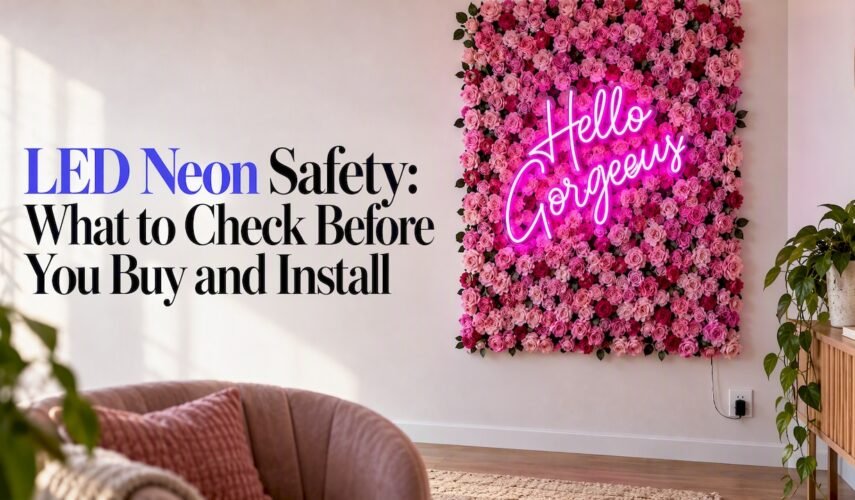
LED neon is safe when the sign is built properly, the power supply is approved for Australia and any mains wiring is done by a licensed electrician. The glowing strip itself contains no neon gas and no glass tube. The real risks sit elsewhere: a dodgy power supply, a sign used outdoors that was never meant to be, or a hardwired install done without a sparky.
This guide covers each of those, plus the toxicity question people ask most, and a checklist you can run before you pay for any sign, ours or anyone else’s.
TL;DR
- LED neon is not toxic. It is a flexible LED strip in a silicone or similar jacket, with no neon gas, mercury or fragile glass tube.
- The part that needs scrutiny is the power supply that plugs into the wall. Look for the Regulatory Compliance Mark (RCM) and check the supplier is registered on the national EESS database.
- Plugging a sign into a power point is a different job from wiring it into the building. Fixed mains connection is licensed electrical work in every state and territory.
- Use a sign outdoors only if it was built and rated for outdoor use, and keep power supplies out of the weather.
- Cheap online electrical items are where most Australian safety warnings come from, so buy from a supplier you can contact if something goes wrong.
Table of Contents
- Is neon toxic? Separating glass neon from LED neon
- Where the real risk is: the power supply
- Plugging in versus hardwiring: when you need an electrician
- Indoor versus outdoor: do not guess
- Heat, fire and mounting
- Our perspective: safety is mostly about what you can’t see
- A pre-purchase checklist
- Choosing a sign that fits your space
- Frequently asked questions
- Sources
Is neon toxic? Separating glass neon from LED neon
People who search “is neon toxic” are usually picturing a traditional glass tube sign. Those signs are made from bent glass filled with a noble gas and powered by a high-voltage transformer. The gas inside is not what people fear in practice. The worries are fragile glass and the high voltage needed to light it.
LED neon works differently. A strip of small LEDs sits inside a flexible diffusing jacket, which gives the continuous glow of a neon tube. It is mounted on a backing board, usually clear acrylic, and it runs from a low-voltage DC power supply. There is no gas to leak and no glass to shatter on a bumped wall.
So the honest answer is that LED neon is not toxic in any way that matters to a household or a venue. Normal use does not release anything harmful. If a sign is physically damaged, treat it as you would any damaged electrical product: unplug it and stop using it until it is checked.
What about the light itself?
Another common question is whether LED light harms your eyes or skin. A US university safety office notes that unless an LED emits UV, it should not be expected to contribute to injuries such as photokeratitis or cataracts. The same page explains that thermal retinal damage needs a very high irradiance over a short exposure, which is not what a decorative sign delivers.
The European Commission’s public health pages, summarising the scientific committee’s opinion, say exposure from LED screens in common devices is well under the safe limits. A neon-style sign is a dimmer, more diffused source than a bare LED bulb, and you do not stare into it from close range. The practical advice is the usual one: do not put a bright sign at eye level directly over a bed, and choose a dimmable sign for bedrooms and nurseries.
If you have a medical condition such as photosensitive epilepsy, or you are sensitive to flashing light, speak to your doctor before installing a sign with flashing or chasing effects. A steady-on sign is a different matter from a flashing one.
Where the real risk is: the power supply
The LED strip runs at low voltage, but it still has to get that power from a 230 V wall socket. A transformer or plug-in adaptor does that job, and it is the component that decides whether a sign is safe. A poorly made one can overheat, lack proper insulation or fail to separate mains from the low-voltage side.
Australia’s Electrical Equipment Safety System (EESS) sets the rules. The EESS in-scope equipment definitions describe regulated low voltage equipment as rated above 50 V AC RMS or 120 V ripple-free DC and below 1000 V AC RMS or 1500 V ripple-free DC. A mains-powered adaptor falls in that world, even if the strip it feeds does not.
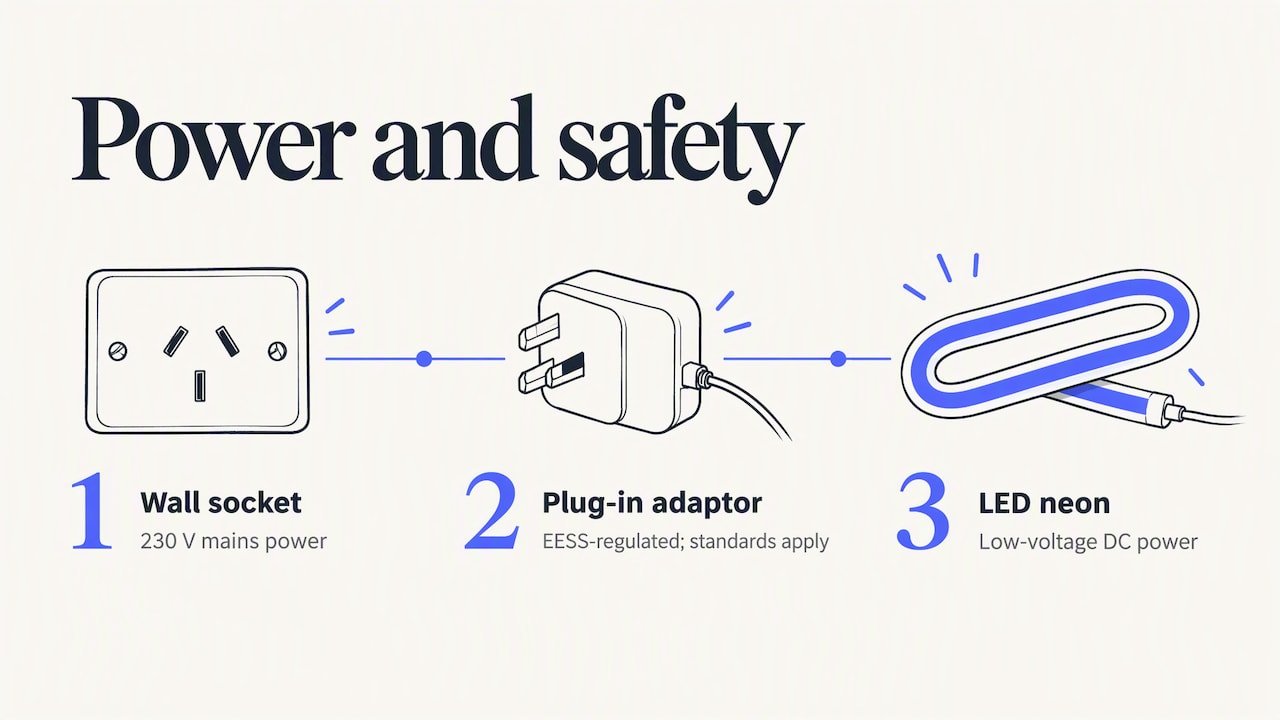
The Tasmanian regulator’s EESS guide explains that the system underpins product safety in Australia and requires compliance with relevant standards. Suppliers carry that obligation, not you as the buyer, which is exactly why you should buy from one you can hold to account.
The RCM tick in a triangle
The Regulatory Compliance Mark is the quickest check you can do. According to the national EESS site, the mark is the most important indicator for electrical equipment sold here, and the product should be linked to a registered Responsible Supplier on the EESS database. A missing mark, or a supplier you cannot find on the database, often means the product was never tested or approved for Australian standards.
Not every risk level of equipment needs the same registration, so do not panic if a minor accessory carries no entry. But for the adaptor that powers a sign and plugs into your wall, ask the seller directly. A reputable seller will answer in a sentence.
Real warnings, recent examples
This is not theoretical. In March 2026, WA’s electrical safety regulator warned owners of a hexagon light kit sold at Bunnings that they were at risk of electric shock and should stop using it immediately. That was a decorative LED wall light from a major retailer, which shows why checking compliance matters even for products that look harmless.
On buying online specifically, Energy Safe Victoria’s brochure Buying electrical equipment online cautions that some items sold on the internet do not meet Australian safety requirements. It cites a 2014 death involving a cheap USB charger that failed Australian standards. A neon sign from an overseas marketplace listing, shipped with a non-compliant plug, carries the same category of risk.
Plugging in versus hardwiring: when you need an electrician
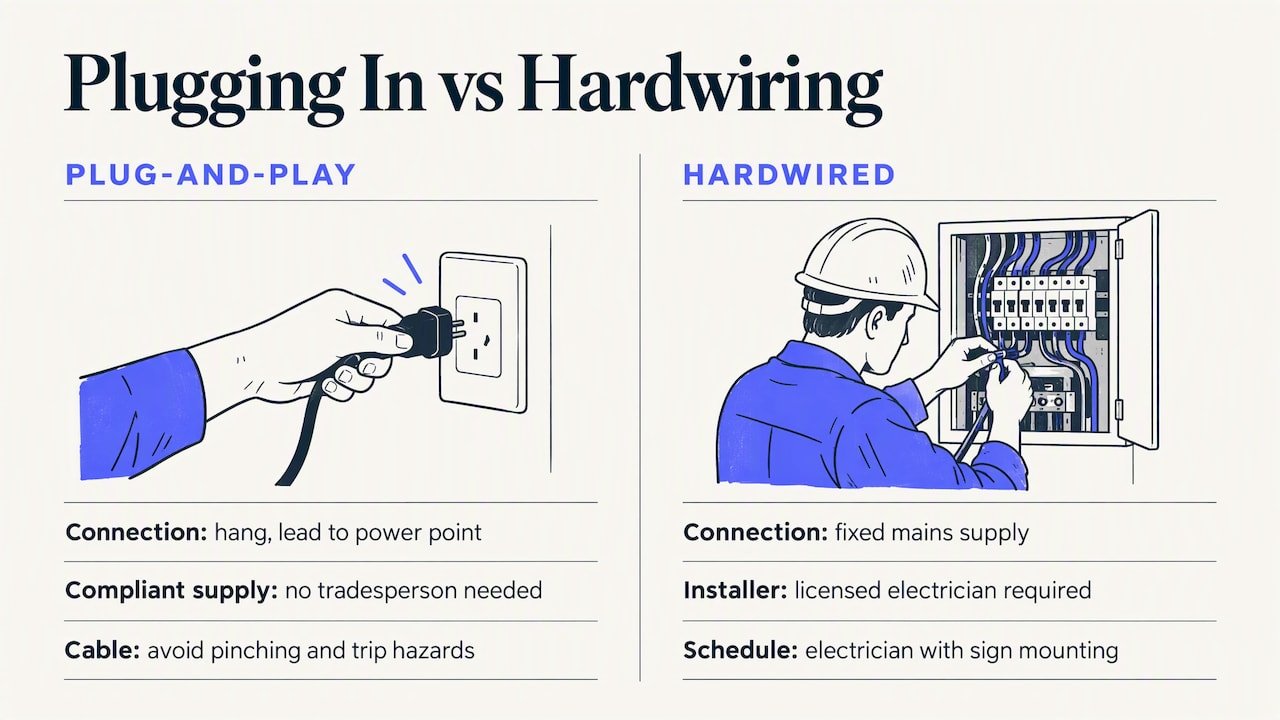
Most home signs are plug-and-play. You hang the sign, run the lead to a power point and switch it on. That needs no tradesperson, provided the supply is compliant and the cable is not stretched, pinched or run where it can be tripped on.
Hardwiring is a different job. A signage safe work method statement published by a workplace safety consultancy says that connecting an illuminated LED or neon sign to a fixed mains supply is electrical installation work under AS/NZS 3000:2018, and must be done by a licensed electrician in every Australian state and territory. Sign installers and riggers can mount the sign, but the final connection is the electrician’s job.
That matters most for shopfronts, restaurants and fit-outs where the sign is wired into a switchboard or a timer. If you are a builder or shop fitter, plan the electrician’s visit into the program, not as an afterthought. Book them for the same day as the sign mounting if you can, so the sign does not sit dark for a week.
Indoor versus outdoor: do not guess
Water and electricity are the dangerous combination here. A sign built for a living wall is not built for a patio, a verandah that gets driving rain, or a window that fogs and drips.
Before you hang a sign anywhere exposed, ask:
- Was this specific sign made for outdoor use, and how is that stated?
- Is the strip sealed against moisture, and what about the cable entry point?
- Where does the power supply sit? Adaptors usually live indoors or in a weatherproof enclosure, not on the wall in the rain.
- Is the sign under cover, or fully exposed to rain, sprinklers or pool splash?
If the answers are vague, treat the sign as indoor only. Even a water-resistant sign should have its power supply protected. Event signs for a marquee or a garden wedding follow the same rule: keep the adaptor and any plug joins up off wet grass, covered, and out of foot traffic.
Heat, fire and mounting
LED neon runs cool compared with glass neon, which is one reason venues and families prefer it. It is still an electrical product, so a few habits help:
- Leave room around the power supply. Do not bury it behind a curtain, under a pile of cushions or in a sealed cupboard.
- Do not coil excess cable tightly while the sign is on. Loop it loosely.
- Mount to the wall with fixings suited to the surface. Plasterboard needs anchors, and a large acrylic-backed sign has real weight.
- Keep signs out of reach of toddlers and pets who chew cables.
- Turn it off at the wall when you leave for a long holiday or if you notice a burning smell, buzzing or flickering.
If a sign heats noticeably at the supply, smells hot, or the lead is damaged, unplug it and contact the seller. Do not open the power supply yourself.
Our perspective: safety is mostly about what you can’t see
We have been building LED neon signs for over a decade, and the same pattern shows up in the questions we get. Customers ask about the glow, the colour and the size. The thing that decides whether a sign is a good purchase is the part tucked behind the wall: the supply, the cable, the sealing.
Our view is simple. A sign should be priced fairly, and it should also be something you can ring about. We offer free design mockups so you see what you are getting before you commit, and we provide local Australian support, so a question about installation, outdoor use or a power supply goes to a person in this country, not into a marketplace message queue.
When a business customer asks about a shopfront or a fit-out, we tell them what we tell everyone: the sign is the easy part, and a hardwired connection belongs with a licensed electrician. When someone wants a sign for a covered outdoor area, we talk through where it will sit before we talk about design. A sign that looks great for three months and then fails in the weather is not a bargain at any price.
If you are unsure whether a design suits your space, ask first. It costs nothing, and it is how most good outcomes start.
— Brett
A pre-purchase checklist
Run through this before paying for any LED neon sign, whoever sells it.
| Check | What a good answer looks like |
|---|---|
| Power supply compliance | RCM mark present, and the supplier can show EESS registration |
| Seller location | An Australian business you can contact by phone or email |
| Indoor or outdoor | Stated clearly for your sign, not implied by a marketing line |
| Installation | Plug-in supply, or advice to use a licensed electrician for fixed wiring |
| Warranty | Written terms that cover the electrical parts, not only the strip |
| Mockup | You see the design and size before production |
| Returns and faults | A clear process if the sign arrives damaged or fails |
If a seller will not answer the first two, walk away. Price is the last thing to compare, not the first.
Choosing a sign that fits your space
Safety and design meet in the planning. A sign meant for a bar wall should be designed with the power point in mind, not found afterwards. A wedding sign that travels between venues needs a robust backing and a lead long enough to reach a socket without stretching across a walkway.
For businesses, think about where the cable runs, whether the sign needs a timer, and whether a hardwired option is the cleaner install. Our custom LED neon signs for businesses page explains how we approach shopfronts, cafes and retail. If you already have a logo, you can upload your image or logo and we will build a mockup from it.
For homes and events, browse the event signs or the neon sign range for ready-made designs. If you want something that exists nowhere else, build your own sign and tell us where it will hang, so we can match the build to the space.
Frequently asked questions
Is LED neon toxic?
No. An LED neon sign has no neon gas, no mercury and no glass tube. It is an LED strip in a flexible jacket, powered at low voltage through an adaptor. If the sign is cracked or the cable is damaged, unplug it and stop using it until it is checked.
Are LED neon signs safe to leave on overnight?
A compliant sign with a properly ventilated power supply is designed for regular use, and LED neon runs cooler than glass neon. Even so, do not cover the supply, and switch the sign off at the wall if you will be away for a long period. A timer is a sensible option for shopfronts. If anything buzzes, flickers or smells hot, switch it off and contact the seller.
Can I use an LED neon sign outdoors?
Only if that particular sign was made for it. Indoor signs are not sealed against rain and splash, and the power supply should always stay protected from the weather. Ask the seller to confirm outdoor suitability in writing before you buy, and tell them how exposed the spot is.
Do I need an electrician to install a neon sign?
For a sign you plug into a power point, no. For a sign connected to the building’s fixed wiring, yes: that is licensed electrical work in every Australian state and territory. If you are not sure which type you have, ask the seller or an electrician before touching any wiring.
How do I know a power supply is approved in Australia?
Look for the RCM mark and ask the supplier for their registration on the EESS database. A missing mark is a warning sign. Be especially careful with products bought from overseas listings, which regulators say may not meet Australian requirements.
Sources
- Regulatory Compliance Mark and EESS database
- EESS in-scope equipment definitions and risk levels
- Tasmania CBOS regulatory guide to the EESS
- Energy Safe Victoria: buying electrical equipment online
- WA Government: electrical safety warning on a hexagon light kit
- Signage installation SWMS information
- Light-Emitting Diodes (LEDs), Berkeley Lab EHS
- Are LED lights safe for human health? European Commission





0 Comments for “LED Neon Safety: What to Check Before You Buy and Install”