 FREE SHIPPING – AUSTRALIA WIDE





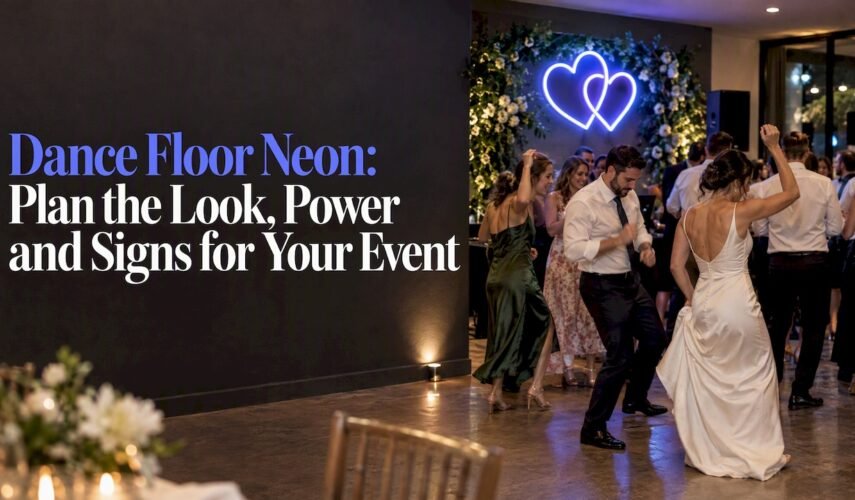
A neon dance floor is two things working together: a light-up floor underfoot and neon-style lighting around it. For most Australian weddings, birthdays and corporate nights, the best result comes from hiring an LED floor for the dancing and adding a custom LED neon sign behind or beside it as the backdrop everyone photographs. This guide covers how big the floor needs to be, what it costs to hire, the power and safety rules people miss, and how to build the neon around it.
TL;DR
- Plan roughly 0.6 square metres per person who will be dancing at once, not per guest. At a wedding that is typically 40-50% of your guest list.
- LED floor hire in Australia commonly starts around $100 to $129 per square metre, depending on the supplier and the state.
- Power is the hidden constraint. A 36 sqm floor can draw upwards of 2,800 watts, and the organiser, not just the hire company, carries responsibility for safe electrical setup.
- Decorative neon never replaces emergency lighting, and LED floor panels need a hard, level surface.
- A custom LED neon sign gives the floor a focal point, draws very little power by comparison, and stays with you after the event.
Table of Contents
- What people actually mean by a neon dance floor
- How big should the floor be?
- What LED dance floor hire costs in Australia
- Power: the part nobody budgets for
- Surfaces and safety
- Why add neon around the floor
- Positioning the sign and the lighting
- Perspective: what we see from the neon side
- Order a sign for your dance floor
- A simple planning timeline
- Common mistakes to avoid
- FAQ
- Sources
What people actually mean by a neon dance floor
Search for the phrase and you will find a mix: hire companies renting LED panels, shops selling glow-in-the-dark runners and UV rugs, and Pinterest boards of coloured geometric floors. They are different products for different jobs.
| Option | Best for | Main limits |
|---|---|---|
| Hired LED floor panels | Weddings, 18ths, 21sts, corporate parties | Needs power, a level surface and a booking |
| Glow-in-the-dark or UV runners | Kids’ parties, small themed nights | Small footprint, needs blacklight, wears quickly |
| Painted or taped floor with neon lighting | Venues you can modify, clubs, bars | Permanent work, needs the venue’s approval |
| LED neon signs and wall art around a plain floor | Any event where you want a look without heavy power | Does not light the floor itself |
The most reliable approach for a one-night event is to combine the first and last rows. Hire the floor for movement and energy. Use a neon sign for the identity of the night: names, a date, a phrase or a logo.
How big should the floor be?
The common mistake is sizing the floor to the guest list. You size it to the number of people dancing at once.
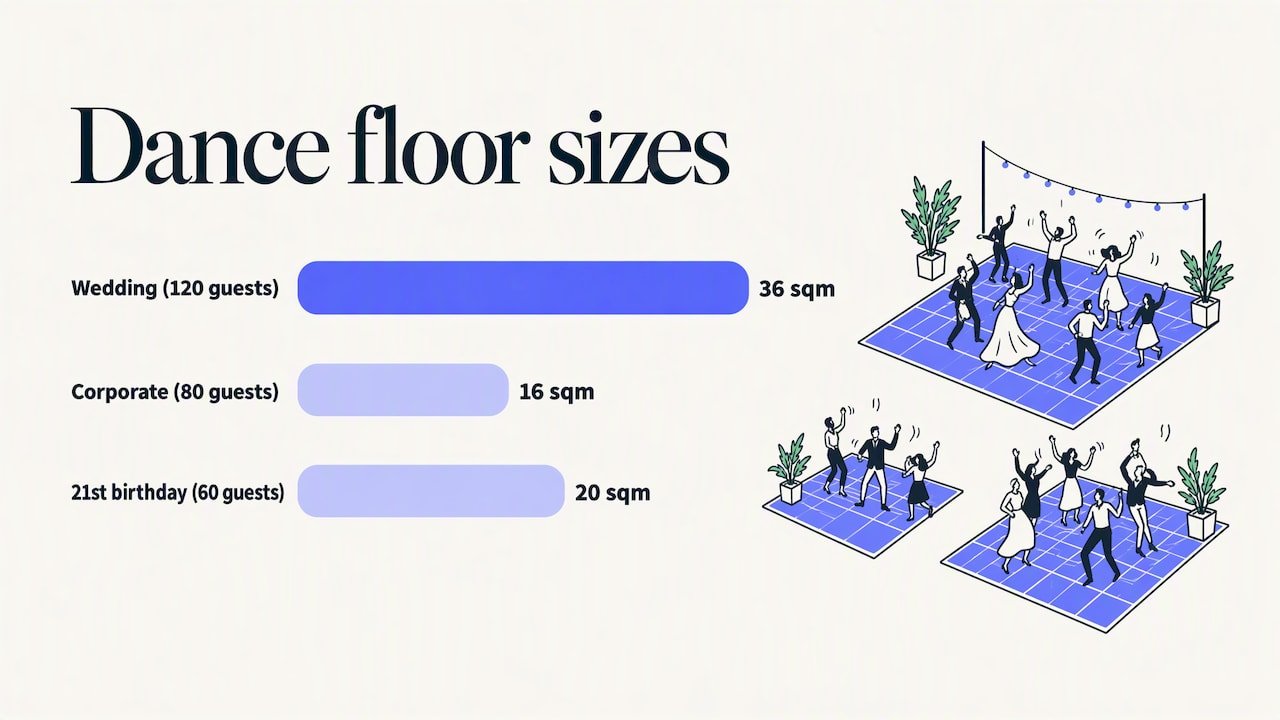
An Australian technical guide from an LED floor hire company uses a comfort figure of 0.6 square metres per person. The same guide gives typical peak usage of 40-50% of guests at weddings, 25-35% at corporate events and up to 60-70% at school formals.
Worked through, using that guide’s examples:
- Wedding, 120 guests: about 36 sqm (a 6 m x 6 m floor).
- Corporate event, 80 guests: about 16 sqm.
- 21st birthday, 60 guests: about 20 sqm. Younger crowds dance for longer and in bigger groups, so the floor is proportionally larger.
If you are between sizes, go up. A crowded floor feels like a party. A floor that is too big for the crowd feels empty, which is the other risk. If your guest list is under 50, a smaller floor with a bold sign behind it often looks better than a large floor with space around the edges.
What LED dance floor hire costs in Australia
Prices move with the supplier, the city, the floor type and delivery. Treat these as starting points and always get the full quote, including delivery, setup, pack-down and any power requirements.
- One Sydney-based hire guide says professional hire generally starts from $129 per square metre.
- A Gold Coast and Brisbane supplier lists its standard floor at $100 per square metre with a 3 m x 3 m minimum, in 50 cm interlocking squares up to 12 m x 12 m.
At those rates, a 6 m x 6 m floor (36 sqm) lands somewhere around $3,600 to $4,644 before extras. Fancier products, such as infinity-mirror or 3D effect panels, usually cost more than a basic LED floor. Ask what is included: some suppliers price the floor only, others include delivery and a technician.
Power: the part nobody budgets for
Venue electrical capacity is the most overlooked part of any LED floor plan. Standard panels draw 50-80 watts per square metre. A 6 m x 6 m floor needs roughly 7.5-12 amps, which can exceed what a standard household circuit handles. A 36 sqm floor can draw upwards of 2,800 watts, according to the same guide.
That matters if you are hosting at home, in a marquee, in a community hall or in a paddock. Before you pay a deposit:
- Ask the venue how many circuits are available near the floor and what else runs on them (bar fridges, DJ gear, caterers’ equipment, a band).
- Tell the hire company the exact location of the power outlets and the floor size.
- Ask whether they need a dedicated circuit or a generator.
- Keep your neon signs on a different circuit from the floor where you can, so a tripped breaker does not take out everything at once.
The rules that apply to temporary electrical setups
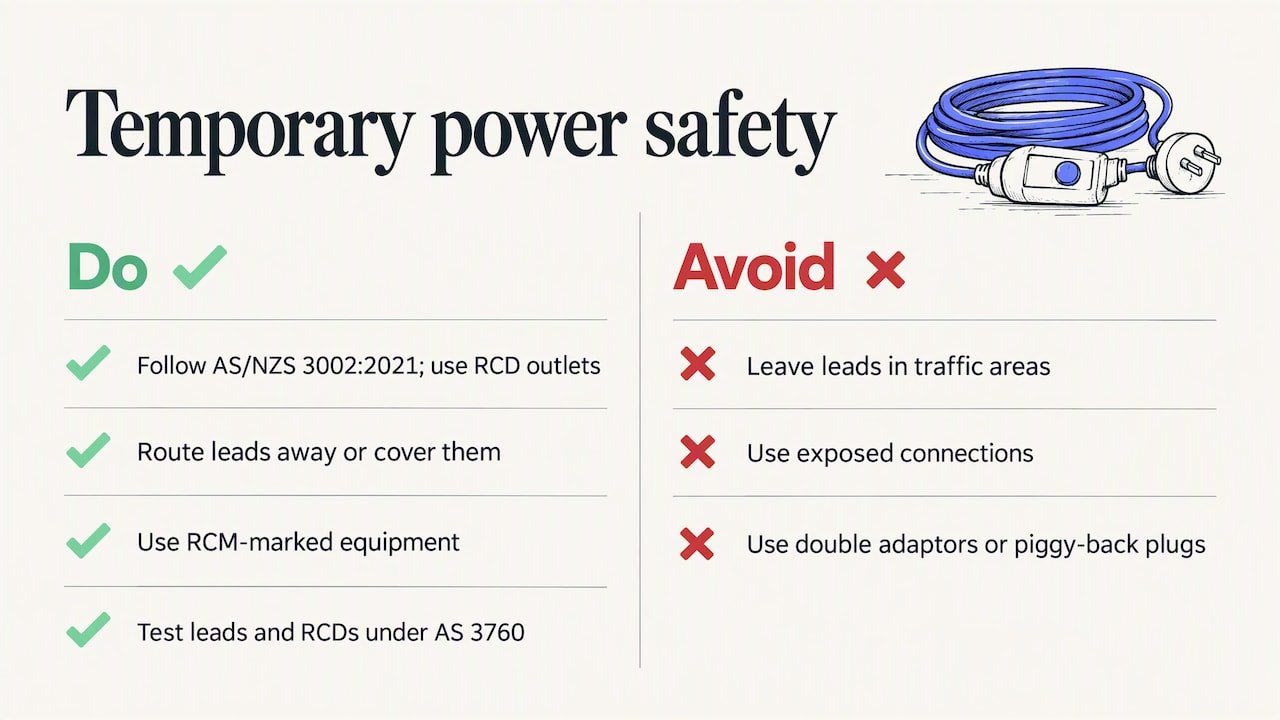
For public events, temporary electrical installations in Australia need to follow AS/NZS 3002:2021, the standard for shows, carnivals and events, which replaced the older version. A City of Perth event guideline says outlets must be protected by residual current devices (RCDs), leads must be kept out of traffic areas or covered, and electrical equipment must carry the Regulatory Compliance Mark. Leads and RCDs also need regular test and tag checks under AS 3760, commonly every 12 months, though some councils want them more often.
Requirements differ by state and council, and a private party in your backyard is treated differently from a ticketed or public event. If you are running something public, contact your local council’s events team early. For anything involving generators, large structures or complex distribution, speak to a licensed electrician. In some cases a licensed contractor must lodge a compliance certificate with the local authority.
Council guidance is also clear that safety rests with the organiser, not only the supplier. Common faults that get events stopped include exposed connections, double adaptors and piggy-back plugs. Treat power as infrastructure, and ask your hire company to confirm in writing who is responsible for testing, tagging and cable protection.
Surfaces and safety
LED panels need a hard, level surface. Installed on grass, carpet or uneven paving, panels can shift, disconnect or get damaged. For an outdoor wedding you will likely need a sub-floor or a levelled platform. Raise it with your hire company when you book, not on the day.
Also keep decorative and safety lighting separate. Western Australia’s health department states that venue egress paths must be able to be lit to 40 lux by lighting independent of event production lights, controlled from a central position, and reaching that level within three seconds. That is WA guidance for public buildings, but the principle applies everywhere: your neon and LED floor are mood lighting. Keep exit signs visible, aisles clear and emergency lighting unblocked, and do not dim the room so far that people cannot see the way out.
Why add neon around the floor
A light-up floor on its own is movement and colour. What it lacks is a message. A neon sign gives guests a place to look, a place to stand for photos and something that reads as designed rather than hired.
LED neon does this well for three practical reasons:
- Low power draw. The floor is the heavy load. One technical source notes that custom LED signs can save up to 70% in energy compared with glass neon in some commercial applications, so a sign adds little to your power plan.
- Light and safe to mount. LED neon runs cool and is far lighter than glass tube, so it hangs on a wall, backdrop or truss without drama.
- It outlasts the night. Hire floors go back. A sign can move to the lounge room, the bar or the shop afterwards.
Ideas that work with a dance floor
- Weddings: names or initials, a date, or a phrase behind the DJ or at the end of the floor. Signs like Just married and Happily ever after suit the head of the floor or the photo corner.
- 21sts and milestone birthdays: the 21 sign is a ready-made backdrop, and it travels home with the birthday person.
- Parties and bars: Let’s party, Good vibes only and Light my fire set the tone without a word of explanation.
- Corporate nights and launches: a logo in neon behind the stage or dance area doubles as a branded photo wall. See our custom LED neon signs for businesses.
For more themes, browse the event signs and bar signs collections, or the gallery to see finished work.
Positioning the sign and the lighting
Few things matter more than where you put things.
- Put the sign at the end of the floor, not over it. Guests dancing under a hanging sign block the view of it. Place it on the long wall, behind the DJ or at the entry to the floor.
- Mind the glare from the floor. Bright LED panels wash out a dim sign. Choose a sign colour that contrasts with your floor programme: warm white or pink against blue-cyan panels reads well; green against a green floor disappears.
- Dim the room, not the safety lights. Neon looks best in lower ambient light. Lower the room lights, but keep exit signs and emergency lighting as required.
- Think photo first. Leave a clear 2 to 3 metres in front of the sign for group shots, outside the main dance traffic.
- Cable neatly. Run the sign’s power lead along the wall behind the sign, covered or taped where people could walk, in line with the lead rules above.
Perspective: what we see from the neon side
We have spent over a decade making LED neon, and the dance floor question comes up most often from people who have already booked the floor and then realise the room still looks flat. A floor gives you colour on the ground. It does not give you a focal point at eye level.
Our advice is to settle the sign early, because a custom design takes time and the best places to hang it depend on the room. Start with the message. If it is a wedding, keep it short: two names or one phrase read from the back of the room. If it is a business event, use your logo as it is, and we can build from an uploaded file.
We also push back on one habit: over-lighting. A busy floor, a wall of fairy lights and a big sign all competing is tiring. Pick the floor as the energy, the sign as the statement and keep the rest quiet. Free design mockups help here, because you can see how the sign sits before you commit.
Finally, treat the power plan as seriously as the design. A sign draws little, so it will not be your problem, but a floor can be. Ask the venue first.
— Brett
Order a sign for your dance floor
If you want the neon part sorted, you have three routes at Oz Neon:
- Pick a ready-made design from our LED neon signs range.
- Use the Build Your Own tool to set your own wording.
- Upload your image or logo and we will turn it into a custom LED neon sign.
We offer free design mockups, a price beat guarantee for custom quotes and local Australian support. Read more about Oz Neon. For a wedding or event, order well ahead of the date so there is time for the mockup, changes and delivery.
A simple planning timeline
- 3 to 4 months out: confirm the venue’s power, surface and bump-in times. Book the floor.
- 8 to 10 weeks out: settle the sign wording and request a mockup.
- 4 to 6 weeks out: approve the design and place your order.
- 1 to 2 weeks out: confirm floor size, delivery window, power plan and who sets up what.
- On the day: test the floor and the sign before guests arrive, check cables, and walk the exits.
Busy periods, such as spring and summer wedding season, book up sooner, so shift everything earlier if your date falls then.
Common mistakes to avoid
- Sizing the floor to the guest count rather than to the number dancing.
- Booking a floor for a lawn or carpet without a sub-floor.
- Plugging everything into one power board or using double adaptors.
- Relying on decorative lighting to light the exits.
- Leaving the sign until the last fortnight.
- Choosing sign colours that fight with the floor programme.
FAQ
How much does a neon dance floor cost in Australia?
Hire prices commonly start around $100 to $129 per square metre, depending on supplier, floor type and location. Delivery, setup and any generator or sub-floor costs can be extra. Ask for a written quote showing everything included.
What size dance floor do I need for 100 guests?
Work out how many will dance at once. At a wedding that is typically 40-50% of guests, so about 40 to 50 people, and at 0.6 sqm each that is roughly 24 to 30 sqm. Younger or party-focused crowds may need more.
Can I put an LED dance floor on grass?
Not directly. Panels need a hard, level surface, and grass or uneven ground can cause them to shift or disconnect. Use a sub-floor or platform and confirm it with your supplier.
Is a neon sign enough instead of a light-up floor?
A sign sets the mood and gives you a backdrop, but it does not light the floor. If you have a small crowd or a venue with limited power, a strong sign with good room lighting can work well. For a big dancing crowd, the floor adds movement.
Do I need to worry about electrical safety at a private party?
The formal rules are aimed at public events, but the sensible practices apply anyway: RCD protection, tested leads, no double adaptors and cables kept out of walkways. For marquees, generators or public events, check with your local council and a licensed electrician.
Sources
- LED Dance Floor Hire in Australia: Technical Specifications, Sizing and What You Need to Know
- Australian Standard 3002: Electrical Installations, Shows and Carnivals (ABLIS)
- City of Perth Event Guidelines
- Electrical and lighting requirements for public buildings (WA Health)
- LED dance floor guide (surface requirements)
- LED light up dance floor hire pricing, Gold Coast and Brisbane



0 Comments for “Dance Floor Neon: Plan the Look, Power and Signs for Your Event”