 FREE SHIPPING – AUSTRALIA WIDE





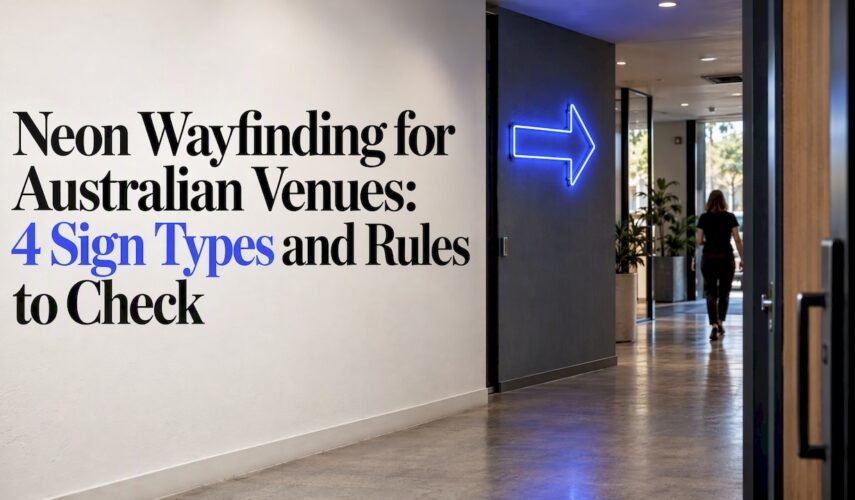
LED neon wayfinding is an effective, brandable way to guide visitors when you design for legibility and accessibility. Pick high-contrast colours, place signs at decision points, and check required signage against the NCC before you order. We can send you a free mockup, so you can see the sign on your wall before anything is built.
TL;DR:
- The NCC sets a 30% minimum luminance contrast for tactile characters; illuminated neon may help, but it does not replace required tactile and braille signs.
- Size signs for their furthest reading point, use bold strokes and tall letters, and test a printed mockup at wall height before ordering.
- Temporary event signs need nearby power and safe cable routes, while permanent installations require a fixed surface, concealed power, and outdoor weatherproofing.
- Ask for warranty terms, repair and replacement procedures, and installation responsibilities in writing; use timers to limit power use to opening hours.
Table of Contents
- Which neon wayfinding signs suit your venue?
- How do you size and place neon signs so people can read them?
- What accessibility rules and Australian standards should you check?
- How do ordering, production and installation work?
- Where does neon wayfinding work best? Ideas and examples
- How do you clean and maintain LED neon wayfinding signs?
- Is LED neon cheaper to run than traditional neon?
- What customisation and smart lighting options are available?
- What warranty and support should you expect from a neon sign supplier?
- A note from us on designing wayfinding that works
- FAQ
- Sources
Which neon wayfinding signs suit your venue?
Most neon wayfinding falls into four types, and matching the type to the job saves you from buying a sign that looks great but sends nobody anywhere.
- Arrow signs: a single bold arrow works at corridor junctions, toilets and exits, where the message is purely directional.
- Text panels: words such as “Bar”, “Cloakroom” or “Entry” suit places where an arrow alone would be ambiguous.
- Pictograms: a hand, an icon or a simple symbol crosses language barriers and reads quickly from a distance.
- Combined art and directional pieces: a phrase sign paired with an arrow gives you atmosphere and direction in one installation.
Temporary and permanent signs need different planning. A rented or one-off event piece usually hangs from a stand, truss or temporary backboard and runs from a nearby power point, so you plan around cable runs and trip hazards. A permanent installation needs a fixed substrate, a concealed power feed and, outdoors, proper weatherproofing.
Decision points matter most: entrances, corridor intersections, the top of stairs and the approach to amenities. Pop-up retail benefits from a clear pointer to the till or fitting rooms, since customers rarely ask.
We feature ready-made pieces that show how this works in practice. Cocktails & dreams suits a bar or event entry. 21 works as a short, punchy marker. The Hand sign doubles as a pointing pictogram. Light my fire makes a warm focal point at a door, and Good vibes only greets guests at hospitality entries.
How do you size and place neon signs so people can read them?
Start with how far away your reader will be when they first need the message. A sign at the end of a long corridor needs thicker strokes and taller letters than one beside a toilet door. The practical rule is to size for the furthest viewing point, not the closest, and to keep the message short enough to read at walking pace.
- Letter height and stroke: go bigger than feels natural in the design stage. Thin script looks lovely up close and disappears across a foyer.
- Colour pairing: pair a bright tube colour with a dark, matte backboard. Warm white, pink and blue on black read cleanly. Two similar mid-tones on a pale wall do not.
- Reflective surfaces: avoid mounting on mirrors, polished stone or glass where glare can wash out the glow and create confusing double images.
- Backboards: a clear or black acrylic backboard holds the LED neon in shape and hides the wiring, and it is part of the look, so we design it as part of the sign. It also gives you the contrast surface the sign needs to be readable.
- Bending limits: LED neon has a minimum bending radius, so check the product specifications before designing tight corners or fine detail. Rounded corners and simplified letterforms work better and read faster anyway.
Pro Tip: Stand where your visitor will stand, hold a printed mockup at wall height and walk away until you cannot read it. That distance is your real viewing limit.
Mounting choices follow from the wall. Standoff mounts give a floating look and a soft glow on the wall behind, flush mounts suit tight corridors, and hanging chains work in open foyers. Check the substrate first: plasterboard needs anchors rated for the weight, brick and concrete take fixings readily, and glass or timber panels each need their own approach.
What accessibility rules and Australian standards should you check?
Neon is a visual accent. It does not replace compliant signage where the NCC requires it, so plan both together.
- Luminance contrast: Specification 15 of the NCC sets braille and tactile signs with a minimum luminance contrast of 30% between characters and background, and it requires signs to be illuminated sufficiently to meet that contrast when needed.
- Illumination is permitted: the NCC lets you use lighting to achieve the contrast, as confirmed by tactile signage specifications, so a lit sign can satisfy the requirement when it stays readable.
- Where tactile and braille signs go: the NCC defers to AS 1428 for where braille and tactile signage are required, and AS 1428.2 guidance on wayfinding also covers letter heights, illumination and viewing distance for visual signage.
- Doors and circulation: keep the approach to signs clear so a person can get close enough to touch or read them.
- Lighting schedules: if you rely on illumination for contrast, make sure it is available whenever the sign needs to be read.
Statistic callout: the NCC sets a minimum luminance contrast of 30% between tactile characters and their background. Treat that as the floor for compliant signs, and use neon as the visible layer on top.
Wayfinding also works best when planned as a whole: direct routes between main entries, tactile ground surface indicators where required, and signs that comply with the NCC, as the NSW Access Guidelines recommend for people with sensory loss. For a specific building, confirm the details with your certifier.
How do ordering, production and installation work?
Good procurement is mostly a clear brief. The steps below are the path from idea to lit sign.
- Send a brief: describe the venue, the message, the viewing distance and any accessibility needs.
- Supply artwork: a logo or sketch in vector form is ideal, and you can upload your image or logo directly.
- Approve a mockup: we show you the design on your wall photo so you can check size, colour and placement before we build.
- Production: we build the sign and backboard to the approved design.
- Delivery and installation: we plan delivery and installation around your site.
Timelines depend on complexity. A simple arrow or phrase moves through quickly, while large installations, intricate shapes and outdoor weatherproofing take longer, so tell us your deadline at the start. Event dates are fixed, so work backwards from the day and leave buffer for mounting and testing.
For the brief, gather site photos, mounting dimensions, the location of the nearest power point, the wall or substrate type and any accessibility requirements. Check the power feed early: a concealed run is tidy but needs planning, and an outdoor sign needs a weatherproof connection and a test before the doors open. Our custom-built business signs service covers production and installation planning for permanent fit-outs.
Where does neon wayfinding work best? Ideas and examples
The best installations feel like part of the room while still pointing the way.
- Event foyers: a cluster of two or three directional pieces at the main entry, each with a short word and a bold arrow, keeps queues moving.
- Entrances: pair a phrase with an arrow, such as a welcome line above a pointer to the cloakroom, so guests get mood and direction together.
- Amenities: an illuminated arrow toward the bathrooms is simple, readable and rarely needs words.
- Retail and hospitality: tie a pointer into your brand wall art so the sign does double duty as decor and direction.
- Compliance plus personality: keep your static tactile and braille signs where the NCC needs them, and use neon accents to catch the eye from further away.
A few of our pieces suggest settings. Cocktails & dreams beside a bar arrow sets the tone for a party. The Hand sign works as a friendly pointer in a boutique. Good vibes only above a doorway tells guests they are in the right place. Our gallery shows more finished installations if you want to see scale and placement in real spaces.
How do you clean and maintain LED neon wayfinding signs?
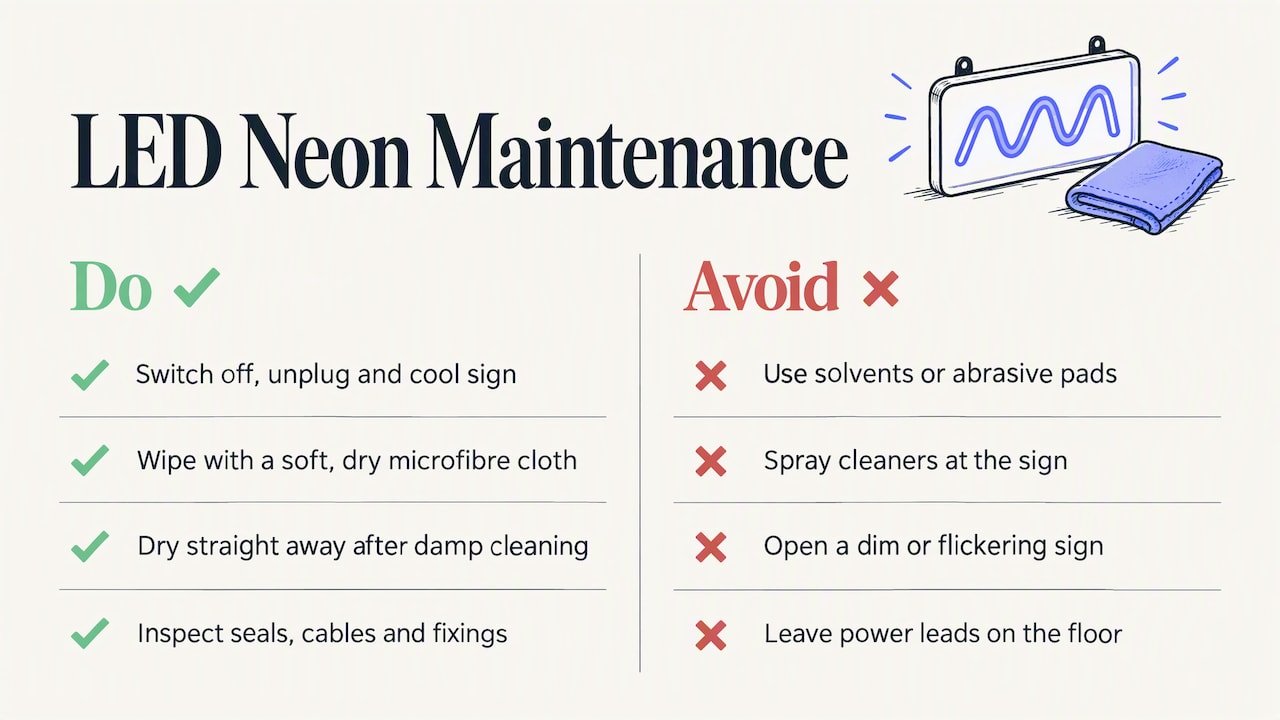
LED neon is forgiving, and a little routine care keeps it looking sharp. Always switch the sign off and unplug it before cleaning, then let it cool for a few minutes.
Wipe the flexible tubing and backboard with a soft, dry microfibre cloth. For marks, dampen the cloth lightly with water and a drop of mild detergent, wipe gently and dry straight away. Avoid solvents, abrasive pads and spray cleaners aimed at the sign, because liquid can reach the connections and harsh chemicals can cloud the tube surface.
Dust is the main enemy in busy venues, as it dulls the glow and makes colours look flat. In a high-traffic foyer, a quick wipe each week keeps contrast crisp, which matters because wayfinding only works if people can read it. Outdoor signs also collect grime, insects and moisture, so inspect the seals and cable entry points regularly.
Check the fixings too. Vibration from doors, crowds and music can loosen mounts over time, so give standoffs and chains a visual check and tighten anything that has shifted. Keep power leads tidy and off the floor so nobody trips on them.
If a section dims, flickers or goes dark, stop using that sign and contact the supplier rather than opening it yourself. Store removable event signs in their original packaging or a padded case, with the tube coiled loosely instead of kinked, so the shape survives from one event to the next.
Is LED neon cheaper to run than traditional neon?
LED neon may be a lower-power option. Compare the power requirements and installation details for the specific sign before choosing.
Compare the power requirements and maintenance needs of the specific glass and LED neon signs you are considering. Check the product details and placement carefully, especially in corridors and areas where people may brush past a sign.
Running cost is only part of the picture. Compare the likely repair and transport needs of the specific signs, as these can affect their overall cost. Check the product’s weight, flexibility and mounting requirements to see whether it suits moving between events and could reduce installation costs.
For a wayfinding sign that stays on during opening hours, the savings show up in the power bill and in fewer service calls. A timer or schedule helps further: if a sign only needs to be lit during trading or an event, switching it off outside those hours cuts consumption again.
When you compare quotes, ask what powers the sign, what the maintenance involves and how replacement parts are handled. A lower purchase price means little if the sign is fragile or costly to keep lit. Our neon sign range shows the available options, and we can quote your exact size.
What customisation and smart lighting options are available?
Customisation is where neon wayfinding becomes yours. Our Build Your Own route lets you start from your own logo or sketch.
Beyond the shape, you can tune the look. Colour choice affects legibility, so we can help you pick a tube colour and backboard pairing that stays readable at your viewing distance. Backboard shape and finish are part of the design too: a cut-to-shape backboard gives a clean silhouette, while a rectangular panel reads more like a traditional sign.
Dimming can be useful for venues that change mood through the day, dropping a sign to a softer level in the evening while keeping it readable. Timers and scheduled switching can suit permanent installs, while a remote or controller can let event teams adjust brightness on the night.
Dynamic effects such as flashing, chasing or colour changes can be used in some sign designs, but use them with care in wayfinding. Movement catches the eye, yet a flickering arrow can confuse more than it guides, so keep directional pieces steady and save effects for decorative art.
Smart control, such as connecting a sign to a schedule or a venue’s lighting system, depends on the specific product and setup, so tell us early if you want it. Ask us about what is practical for your space, and we will confirm what can be built before you commit. Simple, steady and well-placed usually beats clever.
What warranty and support should you expect from a neon sign supplier?
A neon sign is a long-term fixture, so the support behind it matters as much as the glow. Before you order, ask any supplier what the warranty covers, how long it runs and what happens if a section fails.
Good after-sales service starts with a clear answer on repairs and replacements: who diagnoses a fault, whether parts are available and how long a fix takes. For a venue with a fixed opening date, response time counts, so ask how quickly a problem is handled.
We offer warranty options on our signs, along with dedicated local Australian support and a price beat guarantee on custom quotes. Our about page gives more background on how we work. Ask us for the current warranty terms when you request your quote so you have them in writing.
Look for clarity on installation too. If the supplier handles mounting, find out whether that is covered, and what is expected of you on power and substrate. For outdoor signs, confirm the weatherproofing and what conditions the warranty assumes.
Finally, keep your paperwork: the approved mockup, the order confirmation and the warranty terms. If something needs attention later, having those on hand speeds up the whole process and keeps your sign working through every event.
A note from us on designing wayfinding that works
We start every wayfinding job with the same question: can someone read this from where they will actually stand? Beauty comes second to that, and it is rarely a sacrifice, because a bold, simple sign is usually the better-looking one too.
That is why we provide free mockups. Seeing the design on your own wall exposes problems early: a colour that vanishes against the paint, a script too fine for the distance. We would rather fix it on screen than after the sign is built.
We also coordinate the practical side, from site details to installation, and we support Australian customers directly. If you have an event or fit-out coming up, send us your photos and we will show you what is possible.
— Brett
FAQ
What is neon wayfinding?
Neon wayfinding is the use of illuminated neon or LED neon signs to direct people through a space. It includes arrows, words and pictograms placed at decision points, and it doubles as branded decor.
Does LED neon meet Australian accessibility requirements?
Neon can support compliance but does not replace required tactile and braille signs. The NCC allows illumination to help meet a minimum luminance contrast of 30%, so confirm details with your certifier.
How do I choose the right size for a directional neon sign?
Size the sign for the furthest point where someone first needs to read it. Use bold strokes and tall letters, and test a printed mockup at wall height before you order.
Can I use neon wayfinding outdoors?
Yes, with proper weatherproofing, a safe power feed and a suitable mounting surface. Tell us at the briefing stage that the sign is going outside so we can plan for it.
What files do I need to order a custom sign?
A vector logo or clear sketch is ideal, along with site photos, mounting dimensions and your power location. You can upload your image or logo to start.




0 Comments for “Neon Wayfinding for Australian Venues: 4 Sign Types and Rules to Check”