 FREE SHIPPING – AUSTRALIA WIDE





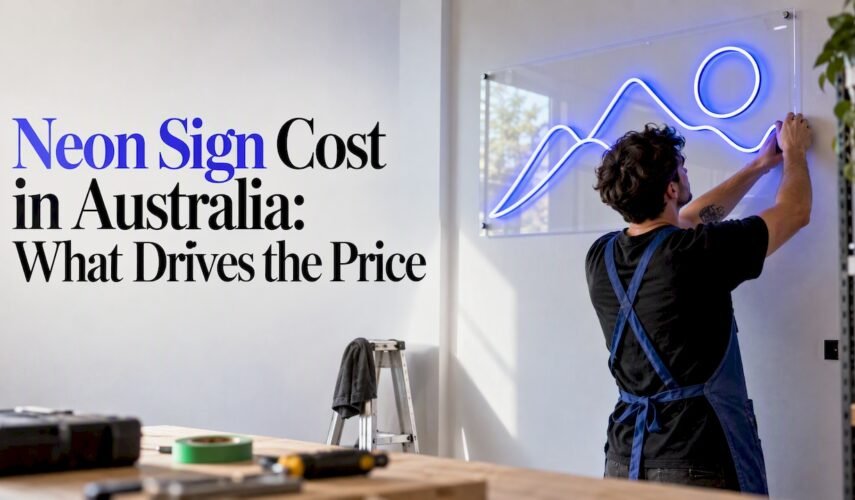
The cost of a neon sign in Australia depends on four things: how big it is, how much tubing the design needs, whether it lives indoors or outside, and how it gets mounted and powered. A short word on a bedroom wall sits at the low end. A detailed logo for a shopfront sits much higher. Colour, on its own, is rarely the thing that moves the number.
We don’t publish a single price list for custom work, because a fair price comes from your actual design. This guide shows you how that price is built, so you can compare quotes properly and avoid paying for things you don’t need.
TL;DR
- Price follows the length of LED tubing and the complexity of the layout, so size and detail matter far more than the words you choose.
- Outdoor signs cost more than indoor ones because they need sealed, weather-rated components and often a licensed electrician.
- Always ask for a design mockup and a written quote that lists size, backing, power supply, dimmer and delivery, so quotes compare like for like.
- Running costs for LED neon are small. The real budget lines are the sign itself, mounting and any electrical work.
- We offer free design mockups and a price beat guarantee on custom quotes, so you can see the sign and the price before you commit.
Table of Contents
- What you are actually paying for
- How size changes the price
- Indoor versus outdoor signs
- Installation and compliance costs for businesses
- Running costs: smaller than you think
- LED neon versus glass neon
- How to get an exact price
- Questions to ask any supplier before you pay
- Our perspective: where people overspend, and where they underspend
- Pre-designed or custom: which is cheaper?
- Order a sign with the price in front of you
- FAQ
- Sources
What you are actually paying for
A custom LED neon sign is a flexible LED tube bent to follow your design, fixed to a backing, and wired to a power supply. Every part of that has a cost, and each one is something you can ask a supplier about.
Tubing length. The longer the continuous run of tube, the more material and the more bending and assembly time. A short word in a simple script uses a fraction of the tube that a full logo with an outline, icon and tagline does.
Layout complexity. Tight curves, sharp corners, overlapping lines and multiple colours all add labour. A single clean line is the cheapest shape to make. Separate letters that have to be wired individually cost more than a connected script.
Backing. Most signs are mounted on clear acrylic cut to the shape of the letters, or on a rectangular board. Shaped cutting takes more work than a plain rectangle. Black or printed backboards change the look and the cost.
Power supply, dimmer and remote. A sign needs a driver to convert mains power to low voltage. Dimmers and remotes are often optional extras, and they are a common source of surprise on the final invoice.
Finish and durability. An indoor sign for a lounge room does not need the sealing that a sign facing the street needs. More on that below.
Delivery and installation. Posting a sign you hang yourself is one thing. Having it mounted, hardwired or fixed high on a facade is another.
How size changes the price
Size is the biggest lever, and it works on tubing length rather than on a simple width-times-height rule. A sign that is twice as wide usually needs a bit more than twice the tube once you allow for letter height, spacing and any outline.
That is why two signs of the same width can have quite different prices. Compare these two examples:
| Design | Typical width | What it involves | Relative cost |
|---|---|---|---|
| One short word in a simple script | Small | One continuous run, one colour | Lowest |
| A name or phrase in two lines | Medium | More tube, more joins | Middle |
| A business logo with icon, outline and text | Medium to large | Many sections, colour changes, cut acrylic | Higher |
| A large outdoor sign for a shopfront | Large | Weather-rated build, bigger power supply, install | Highest |
We have deliberately not put dollar figures in this table. Any fixed figure you see online is a guide for a standard design, and your design will not be standard. The way to get a real number is a mockup, which we cover further down.
How big should your sign be?
A useful rule is to think about viewing distance. A sign meant to be read from a couple of metres, such as a bedroom wall, a bar back wall or a wedding photo corner, can be quite compact. A sign meant to catch attention from across a room, or from the footpath, needs taller letters.
Before ordering, cut a piece of cardboard or tape the outline on the wall at the width you have in mind. Stand where your customers or guests will stand. If you have to squint, go bigger. If it dominates the wall, go smaller. It is far cheaper to adjust on a wall than after the sign is built.
Indoor versus outdoor signs
Outdoor signs cost more, and the reason is not marketing. Moisture, dust, heat and UV all attack electronics and tubing.
According to an Australian signage installation guide, outdoor installations must use components rated IP65 or higher for water and dust resistance. That means sealed connections, a weather-rated power supply and a mounting method that keeps water away from the electrics. Those parts cost more than indoor equivalents, and they take longer to assemble properly.
If your sign is going in a covered alcove, a window facing inwards or a courtyard, tell your supplier exactly where it will sit. A sign behind glass is usually an indoor sign. A sign exposed to rain, even occasionally, is an outdoor one. Be honest about this when you order, because an indoor-rated sign used outside is the most common way a neon sign fails early.
Installation and compliance costs for businesses
Homeowners can usually skip this section. If you are a business, a builder or a shop fitter, read it, because installation is where budgets blow out.
The same signage installation guide notes that plug-in signage is simple to install, but a hardwired commercial sign must comply with the AS/NZS 3000:2018 Wiring Rules. It also says installation can count as High Risk Construction Work under WHS regulations when it involves heights above 2 metres, which calls for a Safe Work Method Statement. In practice, that means hiring a licensed electrician and possibly access equipment, and both are costs on top of the sign.
There is good news. The same guide says a sign of this type is relatively light, at around 2 to 6 kg, so mounting is rarely a structural job. It also advises planning electrical work early, together with other trades, so you avoid site modifications later. If you are fitting out a new venue, ask your electrician to put a power point behind the sign position during first fix. That one decision can save you a lot.
Council rules for external signs
If the sign faces a public street, your local council may have its own rules about illuminated advertising. Councils set technical standards for lighting and advertising devices. Brisbane City Council, for example, publishes advertising devices technical standards that refer to Australian Standards on outdoor lighting. Other councils have their own documents, so check with yours before you order a sign for your facade. Approval fees, where they apply, are separate from the sign price.
If you lease the premises, your landlord may also need to approve the sign. Get that in writing first.
Running costs: smaller than you think
LED neon uses far less power than the glass neon it imitates. As an illustration only, assume a sign draws 30 watts, runs 10 hours a day, and your electricity costs 35 cents per kilowatt hour. That is 0.3 kWh a day, or about 10.5 cents a day, or roughly $38 a year. Check the wattage on your own quote and your own tariff on your bill, then run the same sum.
So for most buyers the running cost is minor. The decision should rest on the upfront price, the build quality and the warranty.
LED neon versus glass neon
Traditional glass neon is hand-bent by a glassblower and filled with gas. It has a distinctive glow, but it is fragile, uses a high-voltage transformer and needs a specialist for repairs. LED neon uses flexible silicone-encased LED strips instead.
For most buyers the practical differences look like this:
- Fragility. LED neon does not shatter, which matters for venues, events and homes with children.
- Heat and voltage. LED neon runs on low voltage and stays cool to touch.
- Weight. It is light, so it hangs on simple fixings.
- Colour range. LED handles a wide palette and dimming easily.
- Cost. LED is generally the more affordable route for custom work, and that is the reason we build in LED.
If you specifically want the look of hand-blown glass for a heritage venue, that is a different product and a different budget. For almost every home, event and business use, LED gives you the look at a friendlier price.
How to get an exact price
Published “from” prices are useful for browsing, but only a quote tied to your design is reliable. This is the process we suggest:
- Decide the purpose and location. Indoor or outdoor, home, shop or event, and the rough wall space you have.
- Gather your design. A text idea, a sketch, a photo or your business logo file will do.
- Ask for a mockup. You should see the sign rendered at its real proportions before paying.
- Get the quote in writing. It should state size in centimetres, backing type, power supply, dimmer or remote, delivery and warranty terms.
- Compare like for like. If one quote leaves out the dimmer or delivery, it is not cheaper, only incomplete.
- Plan the install. For outdoor or hardwired signs, book your electrician before the sign arrives.
Questions to ask any supplier before you pay
A low price means little without these answers.
- Is the quoted size the width of the whole sign, or just the tubing?
- Is the power supply, dimmer and remote included?
- Is the sign rated for outdoor use, and to what level?
- What is the warranty, and what does it cover?
- Who handles support after delivery, and are they in Australia?
- What is the turnaround, and is delivery included?
Our perspective: where people overspend, and where they underspend
We have been building signs for more than a decade, and the same patterns come up again and again.
People overspend by making a design more complex than it needs to be. A logo with fine detail often reads better on a wall when it is simplified to its strongest shapes. Fewer tight curves means less tube, and the sign usually looks cleaner too. When a customer sends us a logo, we look first for what can be simplified without losing what makes it recognisable.
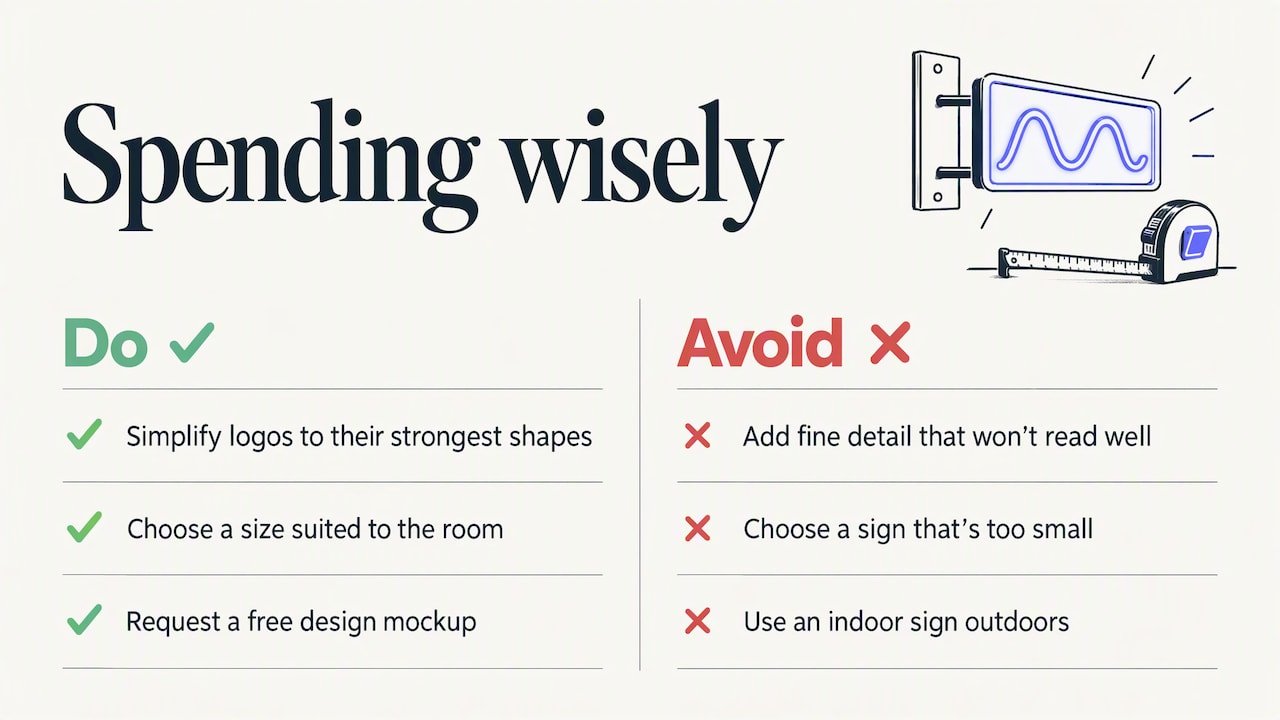
People underspend in two places. The first is sizing: a sign that is too small for the room looks like an afterthought, and the saving disappears when you reorder. The second is outdoor use: trying to save money by putting an indoor sign in the weather costs more in the end.
Our view is that a fair price is one you can see before you commit. That is why we offer free design mockups, and why we stand behind a price beat guarantee on custom quotes. If you already hold a quote, send it to us and we will look at it against your design.
— Brett
Pre-designed or custom: which is cheaper?
If you want something quick and affordable, a pre-designed piece from our wall art and neon sign range is the simplest route. The design is already set, so there is no mockup stage. Popular choices include Good vibes only, Light my fire and Angel Wings. For celebrations, there are Just married, Let’s party and Oh baby. Venues can browse bar signs and open signs.
Go custom when you need your own wording, your logo or a specific size. The extra cost buys exactly the sign you pictured, not the nearest match.
Order a sign with the price in front of you
If you have an idea and want to see it priced, start with our Build Your Own tool. If you already have artwork, upload your image or logo and we will prepare a free mockup. Businesses, shop fitters and builders can read about our custom built LED neon signs for businesses, and you can see finished work in the gallery. If you want to know who is behind the signs, see about Oz Neon.
FAQ
What is the average cost of a neon sign?
There is no single average, because prices run from small, simple text signs to large outdoor logo signs. The price is set mostly by the length of tubing, the complexity of the design and whether the sign is rated for outdoor use. The reliable way to find your number is to request a mockup and written quote for your design.
How much does a custom neon sign cost compared with a pre-designed one?
Pre-designed signs are usually the more economical option because the design work is already done. A custom sign costs more when it involves your own logo, a unique layout or a larger size. In return, you get exactly the wording and proportions you want, and a mockup first.
Do LED neon signs cost much to run?
No. They draw little power, so running costs are small for most buyers. Check the wattage on your quote, multiply by hours used and your tariff in kWh, and you will have your own figure. Our worked example above came to roughly $38 a year, based on assumed figures.
Does installation cost extra?
It can. A plug-in sign you hang yourself needs no installer. A hardwired or outdoor sign may need a licensed electrician, and work at heights above 2 metres can bring extra safety requirements for businesses. Speak to a licensed electrician in your state about your site before you order.
How long does a custom neon sign take?
Turnaround depends on the design, the size and how quickly you approve the mockup. We offer quick turnaround, and we will confirm the timing when you approve your design. If you have an event date, tell us up front so we can plan around it.
Sources
- Signage Installation SWMS Templates, OH Consultant
- Advertising Devices Technical Standards, Brisbane City Council



0 Comments for “Neon Sign Cost in Australia: What Drives the Price”